
Coagulation
Physicochemical destabilization of colloidal particles. Controlled coagulant dosing prepares the fine solids in wastewater for separation in the following stages.
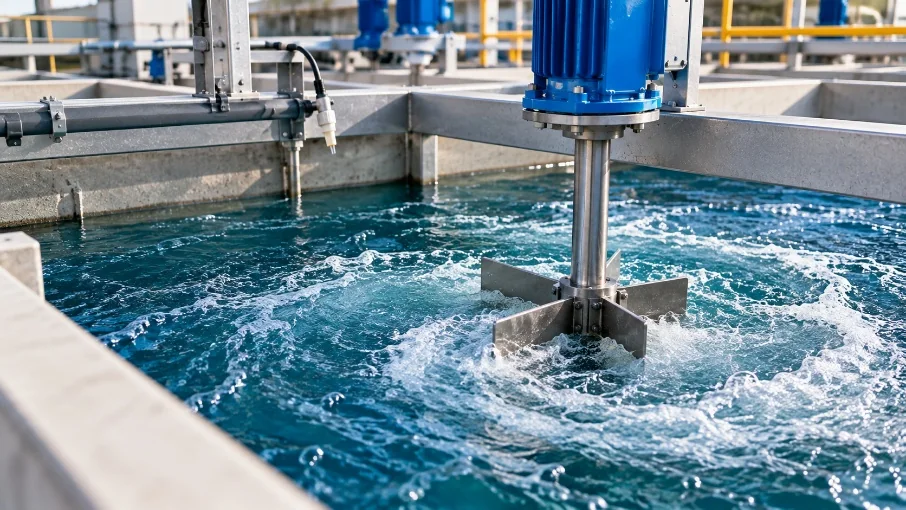
Physicochemical processRapid mixing with coagulant
What is coagulation?
Coagulation is a physicochemical stage designed to destabilize colloidal particles and finely dispersed solids in water, which remain suspended because of electrostatic forces that hinder their natural separation. Controlled dosing of coagulants changes the balance of surface charges, reducing repulsive forces between particles and creating the conditions needed for their subsequent separation.
Process performance depends on the correct selection and dosing of the coagulant, as well as on the physicochemical characteristics of the water. Parameters such as pH, alkalinity, particle concentration, the nature of the contaminants and hydraulic conditions directly influence the treatment response and must be considered to establish suitable operating conditions.
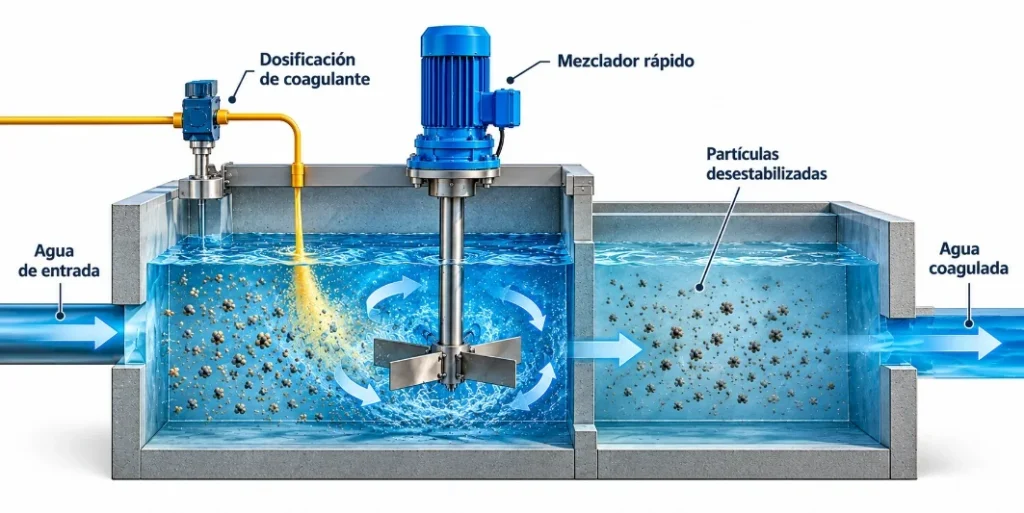
- 1DosingThe coagulant is added in the rapid mixing zone.
- 2DestabilizationRepulsive forces between particles are reduced.
- 3Next stageThe water moves on to flocculation or sedimentation, depending on the process.
Advantages
- High destabilization efficiency. Facilitates the treatment of colloidal particles and finely dispersed solids.
- Improves subsequent separation. Conditions the water for the following treatment stages.
- Controllable dosing. Allows operation to be adjusted to the water characteristics.
- Adaptable process. Can be integrated into different physicochemical treatment configurations.
The process, step by step
The coagulant is added to the water stream in a rapid mixing zone, where high-intensity agitation distributes it uniformly in a short time. During this stage, chemical reactions and interaction mechanisms take place between the species formed by the coagulant and the particles in the water.
Rapid mixing promotes effective contact between the water being treated and the chemical, and creates the conditions needed to start the association of destabilized particles. The flow can then be sent to the flocculation or sedimentation stage, depending on the defined process.
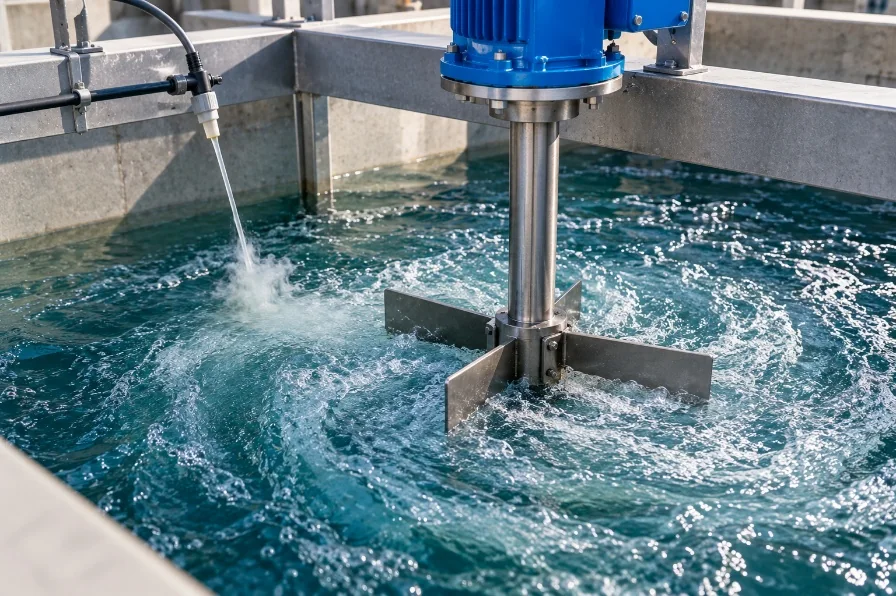
Rapid mixing: the key point
Efficiency starts to be defined in seconds: fast, homogeneous dispersion of the coagulant is decisive for establishing suitable coagulation conditions.
Works well with
Every technology performs better within a well-designed treatment train.
- PhysicochemicalFlocculationClumps destabilized particles into larger flocs through slow mixing.View solution
- PhysicochemicalGEM systemFlocculation and flotation with LSGM heads to separate solids, fats and oils.View solution
- Aerobic biologicalMBBR systemBiofilm on moving carriers that degrades organic matter in a compact reactor.View solution
Need to optimize coagulation of your effluent?
Send us your wastewater characterization and the flow to be treated. We will assess your case and propose the right solution, with local installation and technical service.
Contact us
Office in EcuadorDe los Eucaliptos E8-70 y calle E9, Quito 170307
Phone+593 99 871 1330
+593 2 280 8126
Emailinfo@sanitronec.com
Office hoursMonday to Friday
9:00 a.m.–12:00 p.m. and 1:00–6:00 p.m.
Office in the United States9995 NW 9th St. Circle, Suite 3, Miami, FL 33172
+1 786 972 2008